fiction
Jorge Luis Borges, Ficciones: "Tlön, Uqbar, Orbis Tertius"
Aug 3, 2025

Borges: The Master of Miniature Universes
The opening story of Jorge Luis Borges’s Ficciones is its longest at 20 pages. In those 20 pages, the reader receives a powerful introduction to its author’s favorite symbols, themes and interests. While it’s easy to think of Borges’s work as completely surreal and disconnected from our world, key ideas from "Tlön, Uqbar, Orbis Tertius" defy that notion.

Seeking the Surreal in a World at War
Immediately prior to this story, we learn in the author’s prologue that this work was published in 1941. It was born nearly a generation after World War I and in the midst of World War II.
Remember, before those wars, the West was under the impression that the cycles of history were coming to an end and progress was becoming linear. The future would always be better. Brighter. More humane.
Industrialism produced machines that made it easier to work. Modern medicine extended the lifespan. Humanity seemed to understand itself and our world down to the molecule.
Then came the machine gun. Chemical warfare. Atom bombs. These were apocalyptic curveballs that threw Western narratives about humanism, liberalism and progress for a loop.
The uplifting assumptions that guided the West from the Age of Enlightenment seemed to expire.Its fruits within the Age of Industrialism were shown to manufacture as many miseries as miracles.
Many Western leaders tried to carry on with business as usual. They created treaty organizations and trade agreements. If we did enough business together, we wouldn’t want to bomb each other back to the Stone Age.
Behind the scenes, the key dealmakers behind these treaty organizations built up a stockpile of nuclear warheads just in case.
Many cultural leaders were so disillusioned by the outcomes of both world wars that their new works reflected profound disillusionment and a reactionary urge to merely reverse all the conventions that Western thought had expounded prior to the wars.
Finding Meaning & Enchantment in Absurdity
In "Tlön, Uqbar, Orbis Tertius", Borges lays out a different approach when confronting the apparent collapse of moral and philosophical foundations within the Old World and New World. This different approach is the invention of a next world. This next world is Tlön.
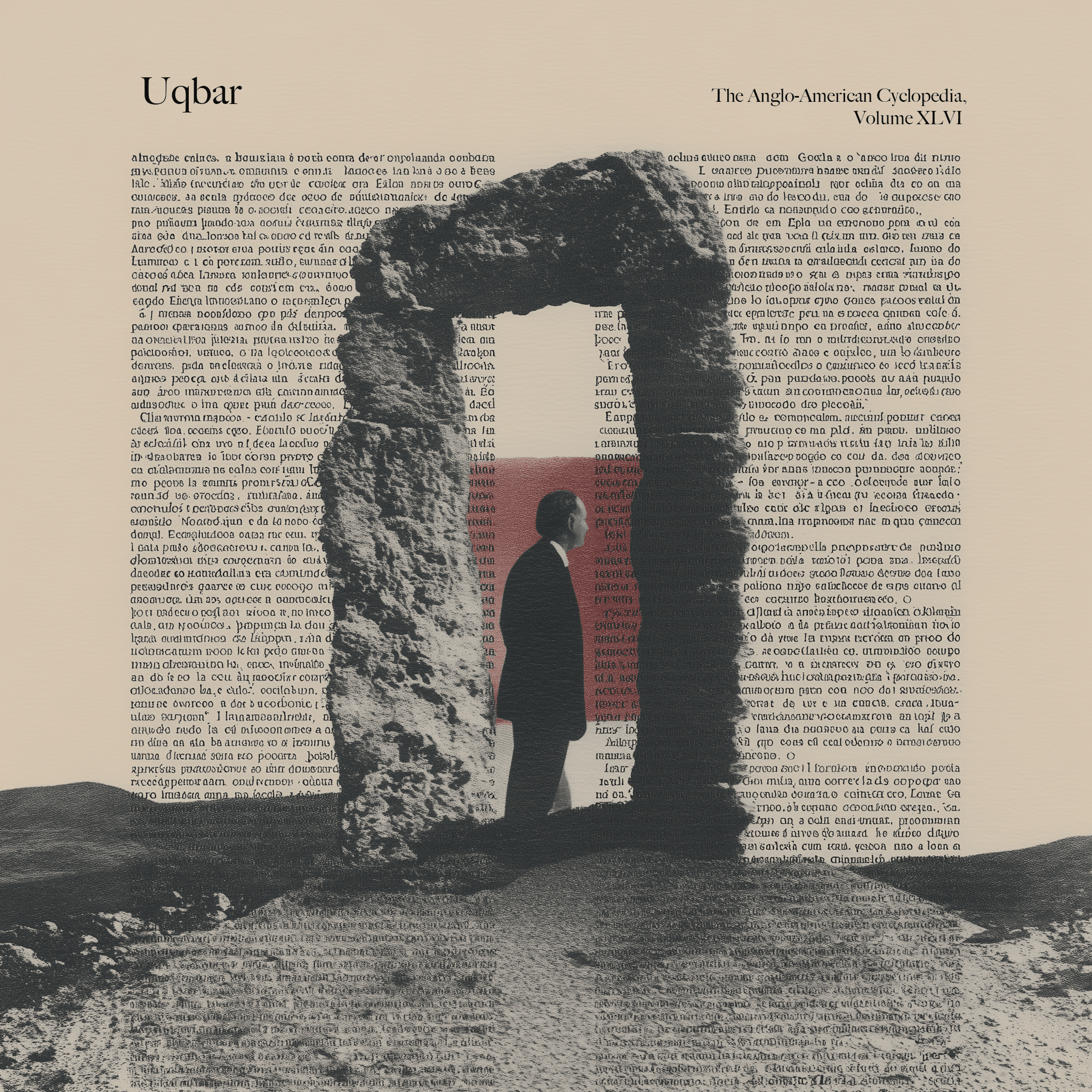
The road to Tlön begins with a strange exchange between two men as they discuss a mirror and an encyclopedia. The encyclopedia is The Anglo-American Cyclopedia, “a literal if inadequate reprint of the 1902 Encyclopedia Britannica.”
It’s mentioned because the narrator’s companion, Bioy Casares, cites a quote about mirrors–“mirrors and copulation are abominable, since they both multiply the numbers of man”– attributed to a heresiarch in The Anglo-American Cyclopedia’s article on the land of Uqbar.
However, when the two men try to find the quote in the encyclopedia, there is neither a quote nor an article on Uqbar. It seems that Casares made the story up about Uqbar in order to avoid taking credit for the comment on why mirrors are abominable…But then Casares calls the narrator the next day and says that he’s looking at the article on Uqbar in his own copy of The Anglo-American Cyclopedia.
From this glitch in the matrix, Borges sets the stage for an ongoing investigation into the nature of reflection, invention and the ways in which our sources of belief reshape our worlds. Mirrors are the symbolic backbone for this investigation.
Beyond the literal mirror that menaces the narrators at the start of the story, Borges turns the entire story into a house of mirrors. The Anglo-American Cyclopedia functions as a mirror of the Encyclopedia Britannica.
Even the tags that Borges attaches to these encyclopedias–Anglo-American versus Britannica–creates a mirror between the last empire in the Old World and the rising empire in the New World. One layer deeper, the premise of an encyclopedia flows from the ambition to create a textual reflection of a real-world domain.
Just as maps–another pet symbol of Borges–tend to put the native country of the mapmaker at the center of the world, an encyclopedia allows domains to be textually encoded according to the worldview of the encyclopedist. In its milder iterations–like an encyclopedia of fruit-bearing trees–the encyclopedist’s ambition seems like the mere desire to compile information.
However, the height of this ambition exemplifies the desire to construct the very boundaries of human knowledge. Within the scope of an empire, we see this ambition through Pliny the Elder’s Naturalis Historia. In support of rebellious aims, we see this through the direction of André Le Breton and Denis Diderot’s Encyclopédie in the lead up to the French Revolution.
By defining the boundaries of human knowledge, an encyclopedist informs how their readers understand the world. One encyclopedist can entrench hegemonic ideas. Another can subvert those hegemonic ideas.
The Encyclopedia: From Mirror to Doorway
As the foundational element within Borges’s first story in Ficciones, the encyclopedia serves as a shorthand reference to the intellectual genealogy of Western thought rooted in the Old World and branching into the New World. From this reference point, Borges turns the encyclopedia into a womb for Tlön, the next world. He summarizes the appeal of this next world by writing:
Ten years ago, any symmetrical system whatsoever which gave the appearance of order–dialectical materialism, anti-Semitism, Nazism–was enough to fascinate men. Why not fall under the spell of Tlön and submit to the minute and vast evidence of an ordered planet? Useless to reply that reality, too, is ordered. It may be so, but in accordance with divine laws–I translate: inhuman laws–which we will never completely perceive. Tlön may be a labyrinth, but it is a labyrinth plotted by men, a labyrinth destined to be deciphered by men.
In this summary of Tlön’s charm, Borges reveals a deeper concern within his anthology. Writing from a world at war for a second time in less than 50 years, Borges’s surrealism amounts to a desire to reexamine the dominant ideologies of his era and imagine an alternative. This desire is emphasized when Borges highlights two guiding parameters within Tlön’s own belief system:
Among the doctrines of Tlön, none has occasioned greater scandal than the doctrine of materialism…The metaphysicians of Tlön are not looking for truth, nor even an approximation of it; they are after a kind of amazement. They consider metaphysics a branch of fantastic literature. They know that a system is nothing more than the subordination of all the aspects of the universe to some one of them.
With this passage, Borges’s own grand ambition–packaged within the apparently modest vehicle of short stories–is revealed. His effort amounts to a total reimagination of the world and its underlying belief systems during a moment of global collapse.
After establishing this ambition in the first story of Ficciones, Borges prepares the reader to experience the implications and possibilities of this reimagined world within the anthology's subsequent stories.